
- Home
- Media Center
-
Events
- Wuzhen Summit
- Regional Forums
- Practice Cases of Jointly Building a Community with a Shared Future in Cyberspace
- World Internet Conference Awards for Pioneering Science and Technology
- The Light of Internet Expo
- Straight to Wuzhen Competition
- Global Youth Leadership Program
- WIC Distinguished Contribution Award
- Membership
- Research & Cooperation
- Digital Academy
-
Reports
- Collection of cases on Jointly Building a Community with a Shared Future in Cyberspace
- Collection of Shortlisted Achievements of World Internet Conference Awards for Pioneering Science and Technology
- Reports on Artificial Intelligence
- Reports on Cross—Border E—Commerce
- Reports on Data
- Outcomes of Think Tank Cooperation Program
- Series on Sovereignty in Cyberspace Theory and Practice
- Other Achievements
- About WIC
- 中文 | EN


Nation in big drive for core tech in key fields



Students watch a humanoid robot performing at the playground of Kuche County Second High School, Xinjiang Uygur autonomous region, on Feb 21. [Photo by Yuan Huanhuan/For China Daily]
Stress on R&D, funding, new laws, policies and colleges defines efforts for edge in chips
Shan Zenghai, chief engineer of Xuzhou Construction Machinery Group, had barely begun his speech when he was recognized by President Xi Jinping, who sat face to face with him at a group deliberation during the annual session of China's national legislature earlier this month.
Xi remembered Shan from a televised interview with deputies to the 14th National People's Congress earlier that day. During the interview, Shan recounted how domestically made heavy machinery has gained presence at home and abroad over the years.
At the deliberation with deputies from the delegation of Jiangsu province, Shan delivered more good news to Xi.
"The 220-(metric) ton all-terrain crane, the model you rode in 2017 during your inspection tour of XCMG, can now be 100 percent domestically produced as compared to 71 percent in the past," Shan told Xi.
"What about the chips in the cranes? Are they also homegrown?" Xi inquired.
Shan's was an affirmative reply.
XCMG's progress on the chips front exemplifies China's efforts to achieve proficiency in the sector that has become strategically important in terms of national security. China's growing capabilities in chipmaking, experts said, are laying a strong foundation for the country's sprawling digital economy.
The latest Government Work Report, revealed during the two sessions, or the top legislative and political advisory meetings, stated that key priorities this year include pooling of quality resources and concerted efforts to achieve breakthroughs in core technologies in key fields.
Jin Zhuanglong, minister of industry and information technology, the nation's top industry regulator, said, "Persistent efforts are needed to tackle problems in crucial technologies."
One of the ministry's top priorities during the 14th Five-Year Plan (2021-25) period is to advance the modernization of industrial chains and encourage companies to develop core technologies, such as high-end semiconductor equipment.
Reflecting the strong resolve is the significant rise in the number of senior executives and academicians involved in the semiconductor sector who are among this year's deputies to the NPC and national political advisers.
For instance, Zhang Suxin, chairman of chipmaker Huahong Group, was elected a deputy to the NPC for the first time. Chen Tianshi, chairman of Cambricon Technology, a Chinese AI chip company, was also elected a national political adviser for the first time.
Other newly elected chip-related national legislators include Li Shushen, a renowned semiconductor expert and president of the University of Chinese Academy of Sciences, and Fu Zhiwei, chairman of Xuzhou B&C Chemical Co Ltd, a domestic company specializing in photoresist, a photosensitive material crucial for chipmaking.
They have all called for more efforts to develop the strategically important sector, including drafting a chip law to pursue breakthroughs.
Xie Shanghua, a member of the 14th National Committee of the Chinese People's Political Consultative Conference, the nation's top political advisory body, said it is necessary to prioritize the development of chips as part of the national security strategy.
In her proposal to the two sessions, Xie said the NPC should take the lead in formulating a chip law, among other measures, to ensure the sustainable, healthy and high-quality development of the semiconductor sector over the medium to long term.
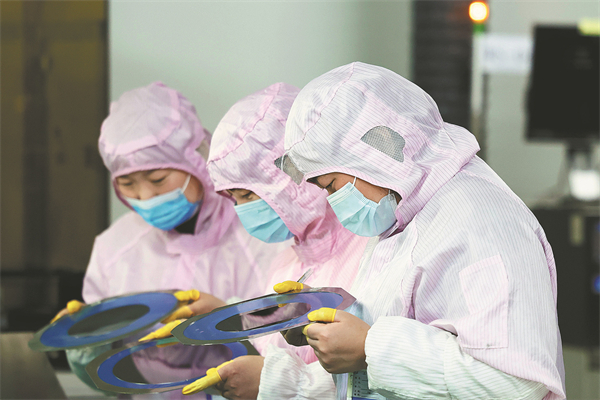
Employees produce chips for export at an electronics enterprise in the Sihong Economic Development Zone in Sihong county, Jiangsu province, on Jan 29. [Photo by Xu Changliang/For China Daily]
"The chip policies that have been issued in China are mainly regulations and departmental rules at the State Council level," Xie said, adding that a chip law enacted by the NPC can help better promote the industry's development.
Efforts should be made to mobilize national resources and to unite leading enterprises to jointly tackle key problems and support the research of equipment components and advanced manufacturing processes of 7 nanometers, 5nm, and 3nm, Xie said.
Xie's proposal follows similar efforts in major economies around the world. The United States, Japan and the European Union are rolling out policies or laws to fuel the development of their homegrown chip industries.
The emphasis on achieving breakthroughs in chips is an important part of China's broader push to hone its science and technological prowess. China's R&D spending exceeded 3 trillion yuan ($436.72 billion) for the first time last year, accounting for 2.55 percent of the country's GDP.
In the 2022 Global Innovation Index, China rose to 11th place, up from 34th in 2012, and firmly remains the only middle-income economy in the top 30, according to the World Intellectual Property Organization.
Yao Lijun, a member of the 14th CPPCC National Committee, called for more efforts to stimulate the innovative vitality of enterprises, in areas such as insufficient R&D funding for some companies and the difficulty in determining the development direction of technology and products.
Yao is also chairman of Konfoong Materials International Co Ltd. Based in Ningbo, Zhejiang province, Konfoong Materials specializes in R&D and production of ultra-high purity metal materials and sputtering targets for ultra-large-scale integrated circuits.
"Now, some manufacturing enterprises in China are still in a relatively low-end industrial chain position, unable to support a large number of scientific and technological research and development projects. It is not easy for enterprises, especially private enterprises, to apply for scientific research funds allocated by the government. There is an urgent need to stimulate the innovative vitality of private enterprises," Yao said.
In his proposal to this year's two sessions, Yao called for the government departments concerned to formulate special policies to support the enhancement of manufacturing enterprises' R&D capabilities, and establish a long-term mechanism to encourage enterprises to improve their R&D core capabilities.
Liu Zhongfan, an academician at the Chinese Academy of Sciences and a 14th CPPCC National Committee member, said building integrated circuit colleges is one of the important measures taken by the country to deal with the "bottlenecks" in the semiconductor sector.
Liu said: "In the future, more universities will join in to establish such academies. The focus should be on cultivating top talent with interdisciplinary capabilities while avoiding too much repetitive investment.
"The fundamental way to solve the challenges in the chip sector is to cultivate leading enterprises with international competitiveness."
Wei Jianguo, a former vice-minister of commerce and vice-chairman of the China Center for International Economic Exchanges, said: "The chip sector is known for being highly intensive in capital, talent and technology. These three factors are all needed to ensure its healthy development. We have to beef up our indigenous R&D push."
Roger Sheng, vice-president of US market research company Gartner, said China is now seeking a more flexible supportive policy to better mobilize resources in the IC sector, so as to avoid wasting time and resources while exploring ways to solve bottlenecks.
As the world's largest chip market, the Chinese mainland consumes more than half of the world's semiconductors, which are then assembled into tech products to be reexported or sold in the domestic market, according to research company Daxue Consulting.
"Access to this massive (Chinese) market is essential for the success of any globally competitive chip firm today and in the future," the Semiconductor Industry Association, a Washington-based group that represents the US semiconductor industry, said in a report.
Meanwhile, the Chinese mainland is also playing an increasingly important role in the global chip manufacturing layout. It accounted for 11 percent of worldwide semiconductor fabrication capacity in 2019, and the figure is forecast to reach 18 percent in 2025 and nearly 19 percent in 2030, according to the SIA.

Students hire a robotaxi from Baidu's Apollo Go, an autonomous driving platform, in Chongqing, on Feb 13. [Photo by Chen Shichuan/For China Daily]
The World Internet Conference (WIC) was established as an international organization on July 12, 2022, headquartered in Beijing, China. It was jointly initiated by Global System for Mobile Communication Association (GSMA), National Computer Network Emergency Response Technical Team/Coordination Center of China (CNCERT), China Internet Network Information Center (CNNIC), Alibaba Group, Tencent, and Zhijiang Lab.